
How to go to a constellation
How to go to a constellation: an inner attitude
How to go to a constellation is one of the most common questions people ask before attending a family constellation. Many feel drawn to the experience, yet they are unsure what it requires from them.
The answer is simpler than expected. It is not about preparation, knowledge, or effort. It is about presence.
A constellation is not a place to do something. It is a place to look.
Beyond expectations
When people wonder how to go to a constellation, they often arrive with expectations. They want to fix a problem, understand a symptom, or change a situation.
Yet expectations tend to close the process rather than open it. A constellation works best when we let go of the desire to control outcomes.
Healing does not happen because we understand more.
It happens because we acknowledge what is.
What family constellations are
Family constellations are a experiential method that makes visible the hidden dynamics within family systems. Through representation, unresolved stories, exclusions, and loyalties can emerge into awareness.
Understanding how to go to a constellation means recognizing that this work does not happen in the mind, but in a deeper field of belonging.
Individual family constellations
Many people ask how to go to a constellation individually. In individual sessions, objects, figures, or guided movements are used instead of group representatives.
Individual constellations are just as powerful. They offer a more intimate and contained space, especially suitable for those who prefer privacy.
What family constellations can help with
Family constellations can bring clarity to:
relationship difficulties
family conflicts
physical symptoms
emotional blocks
professional struggles
a feeling of not belonging
They do not promise miracles. They offer a new perspective.
Looking without judgment
A key part of how to go to a constellation is learning to look without judgment. In every family system there is love, pain, strength, and loss.
When we stop judging, something inside us relaxes.
A wider perspective
Accepting what is creates space.
Space for life to flow again.
How to go to a constellation is about allowing life to be complete, exactly as it is.
An act of humility
Going to a constellation is an act of humility. It means acknowledging that we are part of something larger than ourselves.
Bert Hellinger and the Orders of Love
Family constellations were developed by Bert Hellinger, who observed that love in families follows certain natural orders.
These orders are not moral rules, but movements of life itself.
Understanding them helps us know how to go to a constellation with respect.
The role of the facilitator
The facilitator does not interpret or direct. They observe, wait, and respect the system.
After the constellation
The process continues after the session. Changes often unfold slowly, in daily life.
Knowing how to go to a constellation also means knowing how to leave it: quietly, patiently, and with trust.
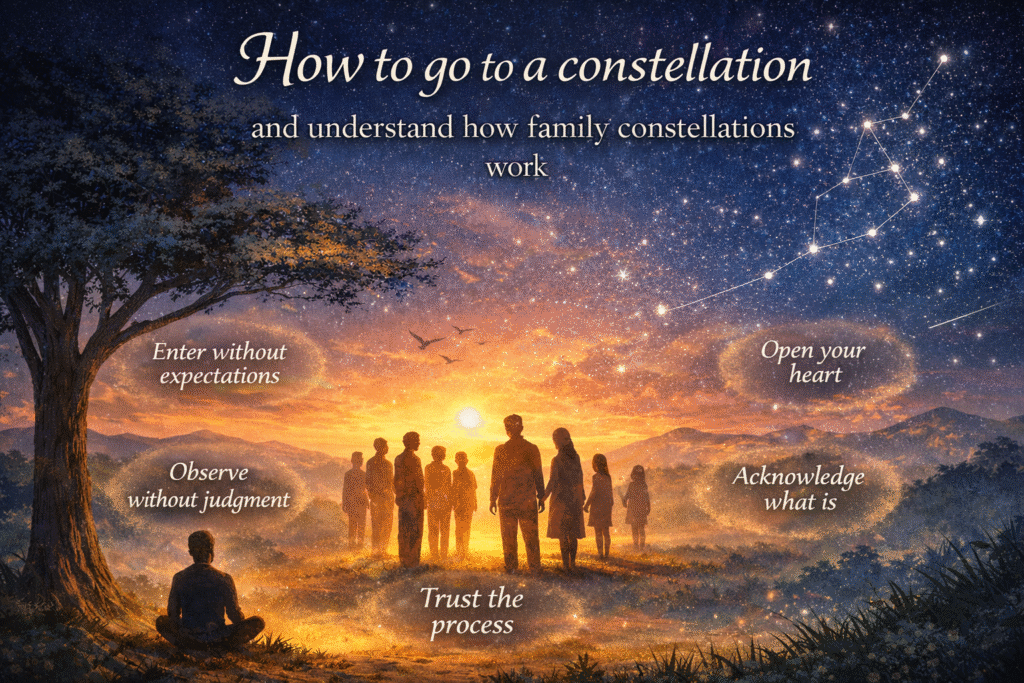
How to go to a constellation and open yourself to experience
How to go to a constellation is a question that arises when something inside asks to be seen. Often, we cannot name it clearly, but we feel that repeating old solutions no longer works.
A constellation is not about blaming or fixing. It is about creating a space where truth can appear gently.
Many people arrive at this work through creative paths. Some encounter it through shows by Kristof in
https://standupclubarg.com/
Others through artistic and personal development courses at
https://standupclubarg.com/escuela-de-stand-up
Kristof’s books, available at
https://standupclubarg.com/tienda
also reflect this human and honest way of looking at life.
Those seeking healing experiences often arrive directly through family constellations at
http://kristoftravel.com/
Sometimes awareness begins in everyday places, such as the Belgian theater bar – Lo del belga
http://lodebelga.com
Even a simple activity like a bike city tour in Buenos Aires
https://argentinievoorbeginners.com/en/home-english/
can open a new way of seeing.
How to go to a constellation ultimately means allowing life to speak, without forcing answers.
How to go to a constellation with Kristof Micholt
A personal path into family constellations
How to go to a constellation is not only a practical question. It is also a personal one. For me, the path into family constellations did not start with a method or a theory, but with my own life questions.
Like many people, I reached a point where repeating old strategies no longer worked. I was looking for clarity, relief, and a deeper understanding of the patterns that kept returning in my relationships and decisions. Family constellations offered something different: not answers, but perspective.
Before guiding others, I had to look at my own family system. That experience taught me that how to go to a constellation begins with humility and honesty toward one’s own story.
Training and learning through experience
My training in family constellations combined systemic work, embodied presence, and direct observation. Over time, I learned that technique is important, but it is never central.
What matters most is the ability to remain present, to respect the family system, and to avoid interfering unnecessarily. Each constellation reinforced the same lesson: when we do less, the system shows more.
Understanding how to go to a constellation also means understanding the role of the facilitator. It is not to fix, interpret, or explain, but to hold space with clarity and respect.
My approach as a constellation facilitator
My way of working is simple and grounded. I do not aim for dramatic movements or fast solutions. I trust the intelligence of the family system and the natural movement toward order.
For me, how to go to a constellation is closely linked to creating a safe and quiet space. A space where the person can stop fighting, stop explaining, and simply be present.
I work slowly, listening carefully, and allowing silence. Often, what brings the most relief is not what is said, but what is finally allowed to be seen.
What a session looks like
When someone asks how to go to a constellation, I first emphasize that there is no need to prepare mentally or emotionally. There is no right way to arrive.
A session usually begins with a brief conversation to clarify the theme. From there, the constellation unfolds naturally, either in a group setting or individually using objects or guided movements.
Every session is unique. There is no script and no fixed outcome. My role is to accompany the process, to protect the field, and to intervene only when necessary.
The importance of inner attitude
More important than the topic itself is the inner attitude. How to go to a constellation depends largely on how one arrives internally.
Coming with openness, without rigid expectations, allows the system to respond. Healing does not occur because something is intellectually understood, but because something finds its place.
When the person relaxes their need to control, the constellation can do its work.
Respect for the family system
One of the foundations of my work is deep respect for every family system. There are no good or bad families, no villains or heroes. There are human destinies.
Learning how to go to a constellation also means learning to look at parents, grandparents, and ancestors as they were, not as we wish they had been.
When respect replaces judgment, something inside begins to soften.
Who this work is for
Family constellations are not for everyone, and not for every moment. How to go to a constellation also involves sensing whether the time is right.
This work is for people who:
feel stuck in repeating patterns
experience unexplained emotional weight
want a broader perspective on their life
are willing to look without blaming
Belief is not required. Willingness is.
What I do not offer
It is important to be clear. I do not promise miracles. I do not give life advice. I do not interpret constellations from a mental framework.
Understanding how to go to a constellation includes knowing what not to expect. The real work continues afterward, in daily life, through small shifts in perception.
Integration after the constellation
After a constellation, I encourage time and silence. There is no need to analyze or explain what happened.
Often, changes appear gradually. Relationships feel different. Decisions become clearer. How to go to a constellation does not end when the session ends; it continues as the movement integrates into life.
A human and simple approach
My commitment as a facilitator is to remain human, present, and respectful. Without dogma. Without pressure.
I believe that how to go to a constellation is ultimately an invitation to meet life with more honesty, humility, and compassion.
A shared journey
Today, I accompany people from different countries and cultures. Despite the differences, the same longing appears again and again: the desire to belong and to live with more inner peace.
That is what gives meaning to this work.
How to go to a constellation is not a technique.
It is an inner gesture.
And from there, something new can begin to take its place.
How to go to a constellation and understand how family constellations work
A simple question with a deep meaning
How to go to a constellation may sound like a practical question, but in reality, it touches something much deeper. Behind it, there is often a longing to understand why certain patterns repeat, why some emotions feel heavier than expected, or why relationships seem stuck.
Family constellations work on a level that goes beyond rational thinking. They do not explain life; they reveal it. Understanding how they work helps us arrive with less fear and more trust.
The systemic field: where constellations unfold
To understand how to go to a constellation, it is helpful to understand the idea of the systemic field. When a constellation begins, a shared field opens. This field contains information about the family system of the person who constellates.
In this field, representatives begin to experience sensations, emotions, or impulses that are not personal, but connected to the system they represent. This happens without acting, imagination, or effort.
The field cannot be forced. It appears when there is presence, respect, and silence.
Representation is not acting
A common misunderstanding is believing that representatives are “playing a role.” In reality, they are sensing.
Knowing this is essential for how to go to a constellation without confusion or unrealistic expectations. Representatives do not invent stories or dramatize emotions. They simply report what they feel in the moment.
This is what allows hidden family dynamics to become visible without analysis or explanation.
Order as a source of relief
Family constellations show that systems follow natural orders. When these orders are disturbed, tension, symptoms, or repeated patterns may appear.
Part of how to go to a constellation is being willing to see where order was interrupted: exclusions, forgotten family members, unresolved losses, or burdens carried for others.
When what was excluded is acknowledged and given a place, the system often relaxes. And when the system relaxes, the person feels relief.
Recognition instead of change
Constellations do not try to change the past. They do not rewrite history or judge what happened.
This is why how to go to a constellation requires letting go of the desire to fix others or to find someone to blame. Healing emerges through recognition, not correction.
When reality is acknowledged as it was, something inside settles.
The role of the facilitator
The facilitator does not lead the constellation with ideas or solutions. Their role is to hold the space, observe carefully, and intervene only when necessary.
Understanding this helps clarify how to go to a constellation. The facilitator is not an expert who knows better, but a guardian of the process and the field.
Often, the most respectful intervention is waiting.
Group and individual constellations
Family constellations can be done in groups or individually. Both formats work equally well.
For those wondering how to go to a constellation individually, the process uses objects, figures, or spatial movements instead of people. The field responds in the same way.
What matters is not the form, but the presence and attitude.
What happens during a constellation
Each constellation unfolds differently. Some movements are clear and emotional, others subtle and quiet.
Part of how to go to a constellation is allowing whatever appears to be enough. There is no need for dramatic experiences or immediate answers.
Even small movements can have a deep impact.
Integration after the constellation
A constellation does not end when the session finishes. The movement continues in life.
That is why how to go to a constellation also includes knowing how to integrate afterward: allowing time, avoiding overanalysis, and trusting the process.
Often, changes show up gradually—in relationships, decisions, or inner calm.
What family constellations are not
It is important to be clear. Family constellations are not fortune-telling, not advice-giving, and not a replacement for medical or psychological treatment.
Understanding this helps answer how to go to a constellation honestly, without false promises.
Constellations complement other paths by offering a systemic perspective.
A deeply human experience
Family constellations work because they touch something universal: the need to belong and the bonds that connect us to our family system.
At their core, how to go to a constellation is about daring to look at one’s own story with less judgment and more humility.
Trusting the process
Nothing in a constellation is forced. Everything unfolds in its own rhythm.
The simplest answer to how to go to a constellation is this:
go with respect, openness, and trust.
When we allow ourselves to be present, the system shows what needs to be seen—and that is often enough for something new to begin to settle.